Christmas Tree Patterns: A Practical Guide to Repeating Holiday Designs
Christmas Tree Patterns refer to abstract, repeatable graphic designs centered around stylized Christmas trees—often paired with complementary motifs like snowflakes, ornaments, or holly. These patterns are typically built on a grid-based structure, enabling seamless tiling across surfaces. Unlike single-illustration holiday graphics, Christmas Tree Patterns are engineered for scalability and repetition, making them especially valuable in print, textile, web, and packaging applications.
What sets Christmas Tree Patterns apart is their intentional balance of tradition and abstraction. Rather than photorealistic depictions, they rely on simplified silhouettes, rhythmic spacing, and controlled color palettes—most commonly red and green, but sometimes extended to include gold, ivory, navy, or charcoal for tonal variation. The inclusion of snowflakes isn’t merely decorative; it adds visual rhythm, breaks up density, and reinforces seasonal context without overcrowding the composition.
How Christmas Tree Patterns Compare to Other Holiday Design Resources
Not all holiday-themed graphics serve the same purpose. Understanding where Christmas Tree Patterns fit within the broader landscape helps clarify their utility—and limitations.
Single-element illustrations (e.g., one isolated tree or a festive banner) work well for logos, social media posts, or greeting cards—but they don’t scale seamlessly across large surfaces like fabric bolts or wall murals. In contrast, Christmas Tree Patterns are built for continuity. Their vector-based EPS files ensure crisp rendering at any size, while high-resolution JPEGs provide immediate usability for digital mockups or web backgrounds.
Photo-based textures or scanned paper patterns offer organic texture and depth, but they lack the precision and editability of structured vector repeats. Christmas Tree Patterns give designers full control over spacing, rotation, color shifts, and motif density—something difficult to achieve with raster-heavy alternatives.
Generative or AI-assisted holiday patterns are increasingly available, but they often lack consistency in motif proportion, alignment, or stylistic cohesion. Professionally crafted Christmas Tree Patterns reflect deliberate design decisions: consistent stroke weights, balanced negative space, and calibrated repetition intervals that avoid visual fatigue.
Strengths and Real-World Fit
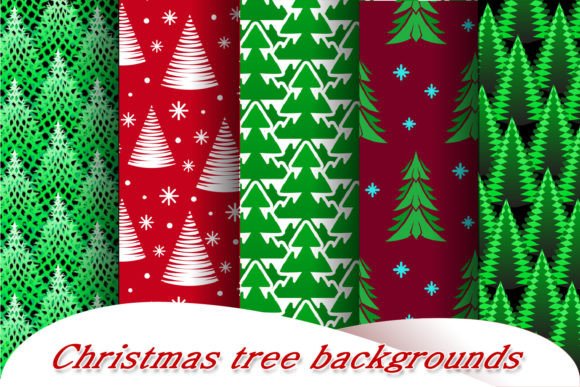
The primary strength of Christmas Tree Patterns lies in versatility across mediums. Because they’re supplied in both JPEG and EPS formats—with five distinct variations included—the same core design can support multiple production needs:
- Printed textiles: Fabric printers use the EPS files to maintain fidelity across yardage; JPEGs help preview drape and scale before cutting.
- Digital interfaces: Web designers apply JPEG versions as CSS background images, adjusting background-size and repeat properties to fine-tune density.
- Packaging and stationery: EPS files integrate cleanly into Adobe Illustrator or Affinity Designer workflows, allowing easy recoloring to match brand palettes.
- Large-format printing: Vector scalability ensures sharp output on banners, window decals, or retail signage—even at 3-meter widths.
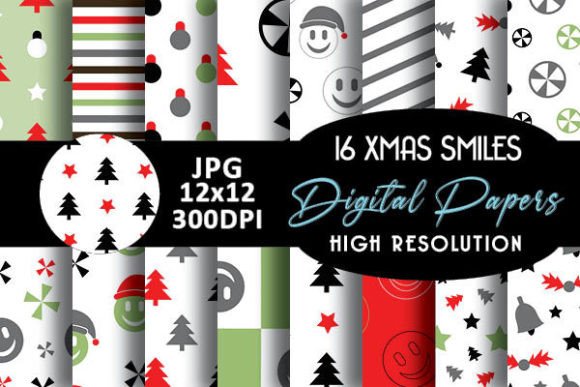
Each of the five included patterns offers a different compositional approach: some emphasize tight, dense repetition ideal for wrapping paper; others use generous spacing and minimalist trees better suited to upholstery or ceramic decals. One features staggered rows for subtle movement; another uses concentric symmetry for a more formal, traditional feel. This variety reflects how Christmas Tree Patterns aren’t a monolithic category—they’re a toolkit shaped by intent.
Tradeoffs and Limitations to Consider
No design resource fits every scenario—and Christmas Tree Patterns are no exception. Their abstraction, while an asset for flexibility, may not suit projects requiring narrative specificity. For example, a children’s book cover needing expressive, character-driven trees would benefit more from custom illustration than a repeating pattern.
Color constraints matter too. While the red-and-green foundation aligns with classic holiday expectations, it can limit adaptability for brands with strict color guidelines—or for audiences preferring modern, muted, or nontraditional palettes. That said, the EPS format allows straightforward recoloring in vector editors, unlike JPEG-only assets where hue shifts risk banding or loss of clarity.
Another practical consideration: licensing. These Christmas Tree Patterns are delivered as ready-to-use files—not subscription-based access or cloud-hosted templates. That means full ownership and offline use, but also no automatic updates or variant generation. Users who need dozens of pattern iterations (e.g., seasonal swaps or A/B testing for e-commerce banners) may find manual customization more time-intensive than using dynamic design platforms.
When Christmas Tree Patterns Are the Right Choice
Christmas Tree Patterns excel when you need consistency, scalability, and production-ready assets—especially if your workflow includes both digital and physical outputs. They’re particularly well-suited for:
- Small-batch product development: Designers launching holiday-themed mugs, tote bags, or notebooks can apply the same pattern across multiple SKUs without redesigning each layout.
- Brand-aligned seasonal campaigns: Marketing teams running coordinated email headers, social tiles, and landing page backgrounds benefit from unified visual language—without needing separate art direction for each channel.
- Educational or craft resources: Teachers creating printable worksheets, scrapbook kits, or classroom decorations gain reusable elements that simplify lesson planning.
- Interior prototyping: Interior designers evaluating wallpaper or upholstery options can quickly test scale and density using the JPEG previews before committing to physical samples.
In these cases, the bundled format—five high-resolution JPEGs plus five editable EPS files in one ZIP folder—adds tangible efficiency. There’s no need to source, license, or convert disparate assets; everything needed for evaluation and implementation is immediately accessible.
When You Might Choose a Different Approach
Christmas Tree Patterns may be less optimal if your priority is storytelling, personalization, or rapid iteration. For instance:
- A wedding invitation suite aiming for hand-drawn charm would likely benefit more from bespoke lettering and custom-drawn trees than a repeatable pattern.
- An app developer building an interactive holiday game might require animated, layered assets—not static repeats.
- A content creator producing weekly Instagram Stories may prefer modular sticker packs over seamless patterns, which require more setup per frame.
Similarly, if your project demands accessibility-first design—such as high-contrast versions for low-vision users—the base red-and-green palette may need thoughtful adaptation. While the EPS files allow for that work, it adds a step not required with pre-optimized accessible templates.
Making an Informed Decision
Choosing whether to use Christmas Tree Patterns ultimately depends on your goals, timeline, technical capacity, and output requirements. Ask yourself:
- Do I need the design to repeat predictably across variable dimensions?
- Will I be working across both digital and print environments?
- Do I have access to vector editing software—or am I relying solely on drag-and-drop tools?
- Is visual consistency across multiple touchpoints more important than unique, one-off imagery?
If most answers trend toward “yes,” Christmas Tree Patterns offer a grounded, production-aware solution. Their value isn’t in novelty—it’s in reliability, adaptability, and quiet professionalism. They don’t shout; they support. And for many practical holiday design challenges, that’s exactly what’s needed.