10 Seamless Dark Blue Striped Patterns: A Practical Guide for Designers and Creators
Seamless dark blue striped patterns offer a versatile, professional foundation for backgrounds, textiles, packaging, web interfaces, and print materials. The 10 Seamless Dark Blue Striped Patterns set stands out not just for its cohesive color palette and precision execution—but for its intentional flexibility across formats and workflows. Unlike generic pattern libraries that prioritize quantity over usability, this collection is built around real-world design constraints: consistent tiling behavior, scalable vector fidelity, and immediate adaptability to project-specific needs.
What Makes This Set Distinct?
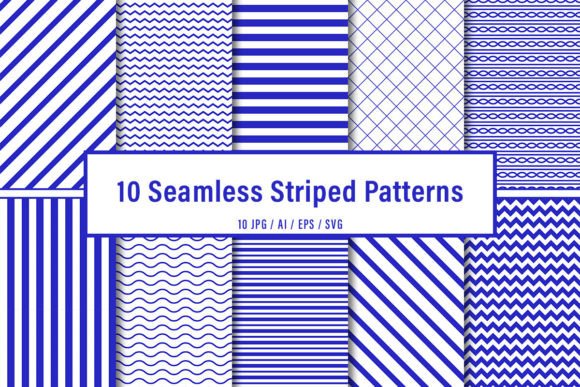
The 10 Seamless Dark Blue Striped Patterns are not random variations. Each pattern balances stripe width, spacing, orientation (horizontal, vertical, diagonal), and subtle texture or contrast shifts—ensuring visual variety without sacrificing harmony. All 10 patterns tile perfectly edge-to-edge in any direction, eliminating visible seams even at large scales or high zoom levels. That reliability matters whether you’re designing a fabric repeat for apparel production or building a responsive website background that must scale across mobile, tablet, and desktop viewports.
What truly differentiates this set is its delivery format. You receive a ZIP folder containing four native file types: AI (Adobe Illustrator), EPS (cross-compatible vector), SVG (web-optimized and code-friendly), and 10 high-resolution JPGs (300 DPI, ideal for mockups or print previews). This multi-format approach supports both creative exploration and technical implementation—no need to convert or risk quality loss mid-project.
How It Compares to Other Pattern Options
Many designers encounter three common alternatives: single-pattern downloads, broad “1000+ pattern” bundles, or custom-built repeats from scratch. Each has tradeoffs.
- Single-pattern files often lack variation—and rarely include editable vector sources. If your layout requires adjusting stripe thickness or shifting hue slightly, you’re limited by raster resolution or locked layers.
- Massive pattern bundles may offer volume but sacrifice cohesion. Finding 10 visually compatible dark blue stripes across hundreds of unrelated designs takes time—and consistency in line weight, contrast, and scale is rarely guaranteed.
- Building patterns from scratch gives full control but demands deep knowledge of repeat mechanics, vector path alignment, and color management. For time-sensitive projects—or when consistency across multiple assets is critical—this approach adds unnecessary overhead.
The 10 Seamless Dark Blue Striped Patterns set bridges that gap: it delivers curated variation with technical readiness. You get the efficiency of a ready-made resource without compromising on editability or aesthetic continuity.
Customization Flexibility: More Than Just Color Swaps
Yes, you can change colors—but the value lies in how easily and reliably you can do so. Because all vector files (AI and EPS) use layered, non-destructive paths and global swatches where appropriate, recoloring is precise and reversible. In Illustrator, a simple Recolor Artwork adjustment updates every stripe uniformly—even across complex diagonal repeats—without distorting alignment or spacing.
SVG files support CSS-based color overrides, making them ideal for dynamic web themes or A/B testing background treatments. And the included JPGs? They’re not placeholders—they’re production-ready references for client presentations or printed swatch books, sized to match industry-standard resolutions.
This level of customization extends beyond hue. Need thinner stripes for a minimalist UI element? Adjust stroke weight in the AI file. Prefer softer contrast for a luxury brand application? Lower opacity or apply subtle gradients in the vector source—then re-export. The patterns behave like tools, not static images.
Where These Patterns Fit Best—And Where They Might Not
The 10 Seamless Dark Blue Striped Patterns excel in contexts where professionalism, subtlety, and scalability intersect:
- Corporate branding assets: Dark blue conveys trust and stability; stripes add rhythm without distraction—ideal for email headers, slide decks, or report templates.
- Fashion and textile design: Repeat accuracy ensures clean fabric printing, especially on woven or knit substrates where misaligned stripes cause visible flaws.
- Digital product interfaces: SVG and optimized JPGs load quickly and scale crisply—useful for dashboard backgrounds, loading states, or subtle section dividers.
- Packaging and label design: Consistent tiling prevents awkward cutoffs on curved or irregular surfaces when applied as wrap-around elements.
That said, this set isn’t designed for maximalist, illustrative, or highly textured aesthetics. If your project calls for hand-drawn brush strokes, watercolor bleed, or photorealistic fabric simulation, these clean vector stripes won’t fulfill that role—and shouldn’t be forced to. Likewise, while the dark blue base is rich and versatile, it’s not inherently accessible at low contrast. Always test foreground text legibility against your chosen stripe variant, especially for digital use.
Practical Evaluation: Key Decision Factors
When deciding whether the 10 Seamless Dark Blue Striped Patterns suit your needs, consider these concrete factors—not abstract promises:
- Workflow integration: Do you primarily use Adobe Creative Cloud? Then the AI and EPS files will slot directly into existing templates. Rely more on Figma or web-first tools? SVG and JPGs give you immediate utility, though editing depth is reduced.
- Output requirements: Are you delivering final art for CMYK print? The EPS and high-res JPGs cover that. Building a React component with dynamic theme switching? SVG + CSS variables become your most valuable asset.
- Variation depth needed: Ten patterns provide meaningful choice—enough to differentiate sections of a long-form report or assign unique backgrounds to team members’ dashboards—without overwhelming selection fatigue.
- Long-term maintainability: Vector sources mean you can update colors, spacing, or proportions years later without hunting for original files. That longevity matters for brand systems intended to evolve.
Real-World Use Cases
A marketing agency used five variants from the 10 Seamless Dark Blue Striped Patterns to create distinct yet unified landing page backgrounds for a financial services client’s campaign series—each aligned with a specific service pillar (e.g., wealth management, retirement planning, risk advisory). Because all patterns shared the same base hue and repeat logic, transitions between pages felt intentional, not disjointed.
A freelance textile designer adapted three patterns into jacquard weave specifications for a menswear line. Using the AI files, they adjusted stripe density to match yarn count constraints—then exported EPS for the mill’s CAD system. The seamless nature eliminated costly physical sampling rounds due to misalignment.
An e-learning platform developer embedded the SVG versions as CSS background images for course module cards. With a small script, they rotated through three stripe orientations based on user engagement metrics—subtly refreshing visual interest without affecting performance or accessibility.
Final Considerations Before Choosing
If your work regularly involves dark blue as a primary or secondary brand color—and you value consistency, scalability, and editable fidelity—the 10 Seamless Dark Blue Striped Patterns offer measurable efficiency gains. You’re not buying decoration; you’re acquiring a reusable, technically sound component library.
But if your projects demand extreme stylistic diversity (e.g., mixing stripes with florals, geometrics, and organic textures in one layout), or if you require patterns in multiple distinct palettes (not just recolorable versions of one), then supplementing this set with additional resources—or opting for a broader, multi-hue bundle—may better serve your workflow.
Ultimately, the strength of the 10 Seamless Dark Blue Striped Patterns lies in its balance: focused enough to ensure coherence, flexible enough to adapt, and technically robust enough to last beyond the current project cycle.