Simple Floral Patterns: High-Resolution Digital Assets for Real Creative Work
When you’re designing invitations, handcrafting greeting cards, or planning a custom fabric print, the right pattern makes all the difference—not just in aesthetics, but in practical usability. Simple Floral Patterns offer that rare balance: timeless elegance paired with immediate versatility. They’re not overly ornate, not too minimal—just thoughtfully composed florals that breathe quietly into your projects without shouting for attention.
What Makes These Simple Floral Patterns Stand Out?
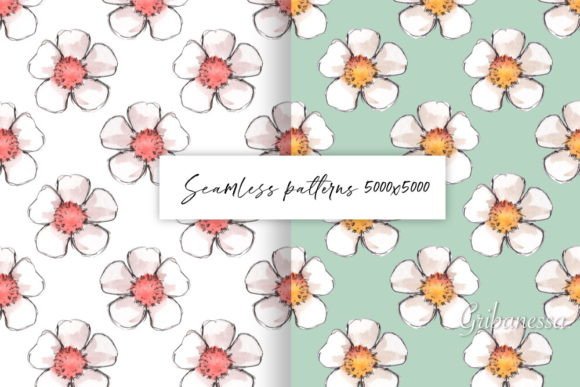
At first glance, they look like delicate, hand-drawn motifs—soft stems, gentle blooms, subtle leaf clusters—but what sets them apart is how they function in real-world creative workflows. Each pattern comes as two high-resolution JPG files, sized at 5000×5000 pixels and rendered at 300 dpi. That’s not just “high-res”—it’s production-ready clarity. Whether you’re printing on fine art paper or scaling up for wall murals, these files hold crisp detail without pixelation or blur.
Unlike many free or low-cost floral patterns online, these aren’t stretched or upscaled. They’re built from the ground up to retain integrity across formats—from tiny 4×6” photo cards to large-format fabric yardage. And because they’re delivered as clean, RGB JPGs (not layered PSDs or vector files), they drop seamlessly into any design software—Canva, Adobe Photoshop, Affinity Designer, Cricut Design Space—even beginner-friendly tools like PicMonkey or Google Slides.
Where These Patterns Shine Most
Simple Floral Patterns excel where flexibility meets intentionality. Here’s where users consistently report the biggest time savings and best results:
- Invitation suites: Layer them subtly behind text, use as borders on save-the-dates, or tile them across full-page backgrounds for wedding stationery—all while keeping readability intact.
- Scrapbooking & memory keeping: Print directly onto cardstock or vellum, cut with precision dies, or use as digital overlays in hybrid layouts. Their light density means photos stay front-and-center.
- Paper crafts & DIY décor: From gift tags and envelope liners to handmade ornaments and party banners—these patterns scale beautifully on laser or inkjet printers, even with lighter-weight papers.
- Fabric & textile applications: Though delivered as JPGs, designers routinely convert them to repeat swatches using tools like Patternodes or Illustrator’s Pattern Maker. The consistent spacing and balanced motif density make tiling intuitive—not guesswork.
- Wall art & home accents: Enlarge and print on canvas, transfer onto wood panels, or use as stencils for hand-painted shelves and frames. The soft contrast ensures clean lines when cutting vinyl or painting freehand.
No Hidden Compromises: What You Get Is What You Use
Many floral pattern packs promise versatility but fall short in execution—repeating awkwardly, lacking color neutrality, or including distracting textures. These Simple Floral Patterns avoid those pitfalls deliberately. They’re designed with intentional negative space, consistent line weight, and a restrained palette that works equally well in grayscale, sepia, pastel overlays, or bold CMYK printing.
There are no watermarks. No licensing restrictions for personal or small-business use. No need to credit Gribanessa unless you choose to—it’s optional, not required. You’re free to recolor, crop, rotate, layer, or combine them with other assets. If you’re building a brand identity for a boutique stationery line—or simply wrapping a birthday present with handmade flair—you keep full creative control.
Why Resolution Matters More Than You Think
That 5000×5000px, 300 dpi specification isn’t just technical jargon—it’s workflow insurance. Consider this: printing a 12×12” scrapbook page at full size requires roughly 3600×3600 pixels at 300 dpi. With these files, you’ve got headroom to zoom, rotate, or add drop shadows without degradation. For fabric designers, it means generating seamless repeats that hold up at 18”×18” swatch sizes—and still translate cleanly to bolt-width printing.
Compare that to common “high-res” files found elsewhere—often 2480×3508px (A4 size) or smaller. Those work fine for digital mockups or social media, but falter when printed large or edited heavily. These Simple Floral Patterns give you room to experiment, adjust, and refine—not just copy-paste and hope.
How to Integrate Them Smoothly Into Your Process
You don’t need advanced skills to get value from these files. Start simple:
- Drag and drop into Canva: Upload both JPGs, set one as background, use the other as a corner accent or frame element. Adjust transparency to 10–20% for a whisper of texture.
- Print on kraft paper or linen cardstock: Use them as full-sheet backgrounds for letterpress-style announcements. The subtle contrast enhances tactile feel without competing visually.
- Create custom washi tape: Tile the pattern horizontally in Photoshop, then export as a narrow strip (e.g., 1000×200px). Print on sticker paper and cut with a craft knife or rotary cutter.
- Design fabric repeats: In Illustrator, define a square swatch, paste the pattern centered inside, then use Object > Pattern > Make. Adjust spacing manually if needed—the even rhythm of the Simple Floral Patterns makes alignment intuitive.
- Hand-lettering companion: Print lightly on tracing paper, place over your calligraphy practice sheet, and let the stems and blossoms guide spacing and flow—especially helpful for beginners learning composition.
Real Projects, Real Results
A small-batch candle maker used one of these Simple Floral Patterns as a base for her soy wax label design—tinted it sage green, overlaid minimalist typography, and printed on recycled kraft labels. Customers repeatedly commented on the “calm, botanical feel.”
A school art teacher printed four variations onto A3 sheets, cut them into strips, and used them for collaborative mural projects with students—no computers required, just glue sticks and creativity. The consistent scale helped unify contributions across age groups.
A wedding planner embedded the patterns into editable PDF templates for clients to personalize—keeping branding cohesive while giving couples freedom to choose colors and fonts. Because the underlying design stayed constant, every version felt intentional, not pieced together.
Choosing the Right Simple Floral Pattern for Your Needs
If you're selecting between multiple floral options—or deciding whether these suit your current project—ask yourself three things:
- Will it be seen up close or from a distance? These patterns work best when detail matters—like on a folded card or framed print—not for massive billboards where subtlety gets lost.
- Do you need color flexibility? Since they’re delivered in neutral tones (often soft greys or muted creams), they adapt easily to Pantone matches, CMYK builds, or even single-color screen printing.
- Is consistency across formats important? If you’re developing a product line—say, matching notebooks, stickers, and tote bags—these patterns maintain visual harmony without needing redesigns for each medium.
They’re not meant to dominate. They’re meant to support—to elevate without overshadowing, to ground without weighing down. That’s the quiet strength of well-designed Simple Floral Patterns.
Final Thought: Quality Assets Multiply Your Time, Not Your To-Do List
Creative work shouldn’t stall because a background looks washed out, a repeat doesn’t align, or a file pixelates when scaled. These Simple Floral Patterns remove friction—not by doing the work for you, but by giving you reliable, adaptable foundations. Whether you’re preparing for a craft fair, launching a micro-brand, or making something meaningful for someone you love, having assets this dependable changes how much you can accomplish—and how good it looks when you do.
Thank you for your thoughtful work. Good luck in your work. Gribanessa.