Coffee Digital Paper Patterns: A Versatile Resource for Designers and Makers
Designers, crafters, educators, and small business owners increasingly rely on high-quality, thematic digital assets to streamline creative workflows and maintain visual consistency. Among the most adaptable and widely applicable resources are Coffee Digital Paper Patterns—a curated collection of repeatable, print-ready textures that evoke the warmth, richness, and tactile nuance of coffee culture. Unlike generic background images or abstract gradients, these patterns carry subtle narrative weight: the soft grain of a pour-over filter, the gentle swirl of cream in a ceramic mug, the matte finish of a hand-stamped café menu. That specificity makes them uniquely effective across disciplines—from branding a specialty roastery to illustrating a lesson on sensory science in a middle-school classroom.
What Makes These 12 Coffee Pattern Digital Papers Distinctive?
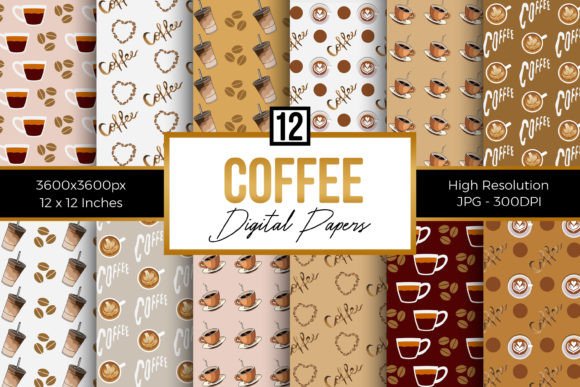
The set of 12 Coffee Pattern Digital Papers stands out not just for its thematic cohesion but for its technical precision and intentional versatility. Each file is delivered as a JPG at 3600 x 3600 pixels (12″ × 12″), rendered at 300 dpi—a resolution standard that satisfies both digital display and professional print requirements. This dual capability eliminates the need for upscaling or format conversion, reducing workflow friction for users who move fluidly between screen-based and physical outputs.
More importantly, each pattern is designed with seamless tiling in mind. Whether it’s a minimalist espresso bean motif arranged in a subtle grid, a watercolor-washed latte art abstraction, or a textured kraft-paper base overlaid with faint coffee stain gradients, every design repeats without visible seams. This characteristic is essential for applications like fabric printing (where continuity across yards matters), website backgrounds (where responsiveness demands scalable tiling), or scrapbook layouts (where repeated elements reinforce rhythm and cohesion).
The color palettes are intentionally restrained—not monochromatic, but grounded in natural coffee tones: warm taupes, deep umbers, creamy ecru, and muted ochres. These hues harmonize with both neutral and vibrant accent colors, making the patterns compatible with diverse brand identities—from earth-conscious wellness startups to modern bakery websites seeking an artisanal aesthetic.
Graphic Design & Branding
For freelance designers building brand systems, Coffee Digital Paper Patterns serve as foundational texture layers. A logo mark placed over a softly grained coffee paper background gains immediate context and tactility—ideal for packaging mockups, social media banners, or pitch decks targeting food-and-beverage clients. Designers have used these papers to create cohesive stationery suites: letterheads with a faint bean-pattern watermark, business cards printed on textured stock with matching digital overlays, and email newsletter headers that echo the same organic rhythm.
Educational Materials & Visual Learning
Instructors developing STEM or humanities curricula find value in the patterns’ capacity to humanize data. A biology teacher illustrating plant cell structure might overlay a coffee leaf vein pattern beneath a labeled diagram; a history educator designing a unit on global trade could use a parchment-style coffee paper as the background for timelines tracing the spread of coffee cultivation. Because the files are high-resolution and copyright-cleared for personal and commercial use, they integrate seamlessly into slide decks, printable worksheets, and interactive PDFs—no attribution required, no licensing ambiguity.
Crafting, Scrapbooking & DIY Projects
Hobbyists benefit from the practicality embedded in the file specifications. The 12″ × 12″ dimension aligns directly with standard scrapbook page sizes and cutting machine mats (e.g., Cricut or Silhouette). Users report printing individual patterns onto cardstock for custom gift tags, layering them digitally beneath handwritten journal entries in Procreate, or using them as templates for embossing folders. One textile artist shared how she scaled the patterns to 150% and printed them onto transfer paper for iron-on designs on aprons and tote bags—achieving a look that mimics hand-blocked fabric without requiring carving skills or ink mixing.
Digital Product Development
Developers building niche tools for creatives—including Notion templates, Canva brand kits, or Figma UI libraries—leverage these papers as “texture anchors.” A productivity planner themed around mindful morning routines uses a steam-diffused coffee pattern as its cover background; a Canva template pack for café owners includes pre-sized Instagram story frames layered with translucent coffee paper overlays. Because all 12 patterns share consistent resolution and color space (sRGB), they behave predictably across platforms—no unexpected shifts in contrast or saturation when exported or embedded.
Workflow Integration: How Designers Actually Use Them
Integration begins before opening Photoshop or Illustrator. Many professionals start by organizing the 12 Digital papers within 1 zip file into logical subfolders: “Subtle Textures,” “Bold Motifs,” and “Neutral Bases.” This simple step supports rapid iteration—when designing a product label, for example, a designer may test three variations in under two minutes: one with a fine-ground coffee grain for sophistication, another with a bold bean silhouette for playfulness, and a third with a cream-swirl gradient for approachability.
In Adobe Creative Cloud, users commonly place the JPGs as Smart Objects, enabling non-destructive scaling and blending mode adjustments (e.g., Multiply for subtle depth, Overlay for enhanced contrast). For web use, developers export optimized PNGs with transparency where needed—or apply CSS background-repeat rules directly, confident the tile alignment holds at any viewport width.
Print professionals appreciate that the 300dpi resolution meets industry benchmarks for offset and digital press work. When preparing files for fabric printing services like Spoonflower or Printful, designers confirm that the patterns fall within the recommended DPI range and avoid unintended pixelation—even when scaled to cover large-format yardage. No interpolation artifacts, no blurry edges: just consistent, reliable texture.
Considerations for Ethical and Effective Use
While Coffee Digital Paper Patterns offer broad utility, thoughtful application enhances their impact. First, avoid overloading compositions—using more than one coffee-themed pattern in a single layout can dilute focus and introduce visual competition. Instead, pair one coffee paper with a clean sans-serif typeface or a solid-color accent to let the texture breathe.
Second, consider cultural resonance. Coffee carries layered meanings across geographies: ritual, labor, colonial history, sustainability, innovation. A pattern evoking burlap sack textures may resonate deeply with audiences valuing ethical sourcing—but could unintentionally evoke scarcity or hardship if used without contextual awareness. Designers working globally often select patterns with abstracted or stylized motifs rather than literal depictions when addressing diverse or sensitive audiences.
Third, accessibility matters. While the patterns themselves are visual, their use should not compromise readability. Placing light text over a light-toned coffee paper—or dark text over a busy bean cluster—reduces legibility. Best practice: test contrast ratios using browser extensions or built-in design tool checkers, and always provide fallback solid-color backgrounds in responsive layouts.
Why Resolution and Format Choice Matter Beyond Aesthetics
The decision to deliver all files as high-resolution JPGs—not PNGs, SVGs, or PSDs—is deliberate and user-centered. JPG offers near-universal compatibility: it opens instantly in Preview (macOS), Photos (Windows), Affinity apps, GIMP, and even basic mobile editors. Designers collaborating with non-technical stakeholders (e.g., café owners managing their own social media) can share the ZIP file knowing the recipient won’t need specialized software to preview or insert the assets.
The 3600 × 3600 pixel dimension strikes a functional balance: large enough to support cropping (e.g., extracting a 1080 × 1080 square for Instagram posts), yet manageable in file size (typically 3–6 MB per JPG)—avoiding upload timeouts on platforms with strict limits. And because the patterns are raster-based—not vector—they retain their organic, slightly imperfect quality: no sterile sharpness, no artificial uniformity. That imperfection is, in fact, part of their authenticity.
Expanding Creative Possibilities Through Intentional Repetition
At their core, Coffee Digital Paper Patterns exemplify how repetition—when thoughtfully composed—can generate variety. The 12 included designs vary in scale, density, contrast, and implied motion: some suggest stillness (a flat-lay of dried coffee cherries), others imply transformation (steam rising in delicate wisps). This variation allows creators to signal tone shifts without changing themes—switching from a “calm brew” pattern to a “vibrant roast” pattern communicates energy and freshness, all while staying within the same conceptual universe.
That coherence supports long-term projects. An educator developing a year-long curriculum on sustainability might use one coffee paper for introductory materials (soft, grounded), transition to a more structured grid pattern for data-heavy units, and conclude with a rich, saturated pattern for capstone presentations—creating a visual arc that mirrors pedagogical progression.
Ultimately, the strength of these 12 Coffee Pattern Digital Papers lies not in novelty alone, but in reliability: they function as quiet collaborators in creative processes—never demanding attention, yet consistently elevating output through texture, intention, and technical integrity.