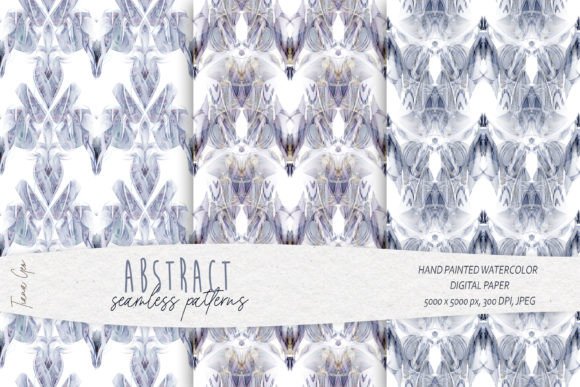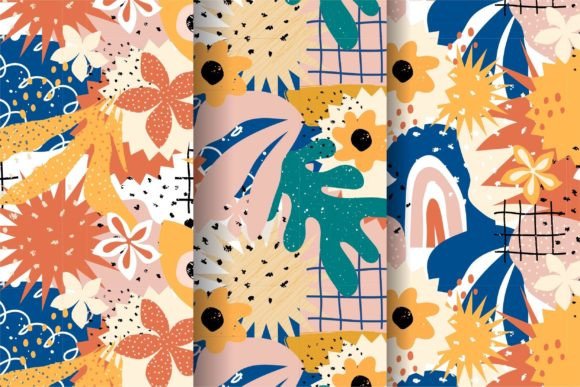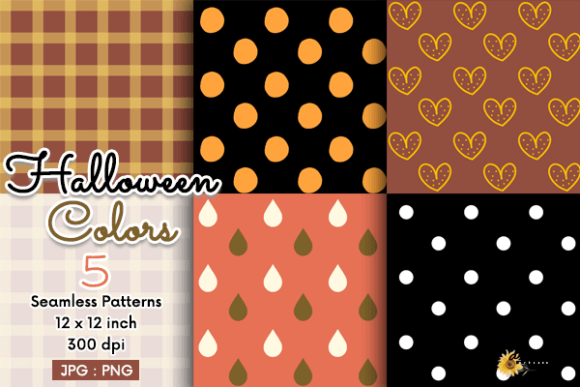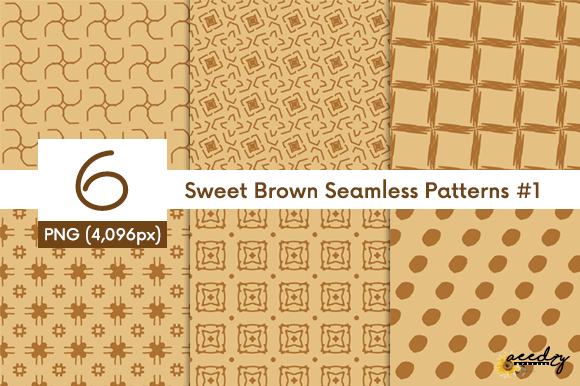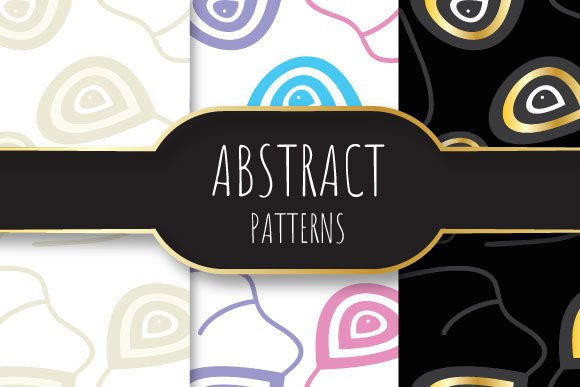
Abstract Patterns: Seamless Vector Designs for Precision-Driven Creative Work
Abstract Patterns represent a foundational category of digital design assets—non-representational, mathematically coherent arrangements that rely on repetition, symmetry, rhythm, and spatial logic rather than figurative imagery. Unlike photographic textures or hand-drawn motifs, these patterns are built from vector geometry: paths, curves, anchors, and Bezier handles—elements that scale infinitely without degradation. When engineered to repeat seamlessly—meaning the right edge aligns perfectly with the left, and the top with the bottom—they become modular building blocks for surfaces, interfaces, branding systems, packaging, and large-format print.
Why Seamless Repeating Vector Patterns Matter in Practice
The seamlessness of a vector pattern isn’t merely aesthetic—it’s functional precision. A non-seamless tile introduces visible breaks or misalignments when tiled across a wall mural, fabric bolt, website background, or UI component grid. Seamless repeating vector patterns eliminate those fractures by design. Each tile edge is constructed so its terminal path coordinates match the origin point of the adjacent tile. This requires deliberate anchor placement, consistent stroke weights, and balanced negative space—not just visual harmony, but geometric fidelity.
Consider a textile designer developing a limited-run linen collection. They source an Abstract Pattern set sized to 12 × 12 inches at 3600 × 3600 pixels, 300 dpi. That resolution ensures crisp output whether printed on a 48-inch wide fabric printer or scaled down for a product label. The vector foundation (EPS 10) guarantees that if the client later requests a custom crop for embroidery digitization or a 10-foot trade show backdrop, no re-rasterization or interpolation is needed—the shapes retain their integrity at any dimension.
Technical Specifications as Enablers, Not Constraints
The stated specifications—12 × 12 inches, 3600 × 3600 pixels, 300 dpi, EPS 10, delivered in a ZIP with three EPS and three JPEG files—are not arbitrary benchmarks. They reflect real-world production thresholds:
- 12 × 12 inches is a standard tile size used across print-on-demand platforms, CAD nesting software, and textile loom programming. It offers enough compositional space for complexity without overwhelming file handling.
- 3600 × 3600 pixels at 300 dpi translates directly to high-fidelity raster preview capability. At 300 dots per inch, this resolves to exactly 12 inches—making it ideal for press-ready mockups, client presentations, or web-based design tools that require pixel-perfect previews while preserving vector editability.
- EPS 10 format ensures backward compatibility with legacy prepress workflows (common in commercial printing houses), full support for transparency and gradient meshes in Adobe Illustrator, and reliable embedding in InDesign layouts—even when shared across macOS and Windows environments.
- ZIP delivery with parallel EPS and JPEG files bridges workflow gaps: designers open EPS files for editing and scaling; marketers insert JPEGs into slide decks or CMS editors where vector support is limited; developers extract color values or test tiling behavior in code environments using the raster variants.
This dual-format delivery reflects an understanding of how creative teams operate—not as isolated roles, but as interdependent nodes in a production chain.
Who Uses These Assets—and How Their Needs Shape Design Decisions
Abstract Patterns serve diverse users, each interacting with them differently:
Educators and Researchers
In design pedagogy, instructors use seamless vector tiles to demonstrate tessellation principles, symmetry groups (p1, p2, p4m), and algorithmic composition. A researcher studying perceptual load in UI backgrounds might select a low-contrast Abstract Pattern with subtle frequency variation—then isolate one tile to measure eye-tracking response time versus a solid-color control. The consistency of the 3600 × 3600 pixel JPEG ensures replicable experimental conditions across devices.
Product Designers and Packaging Engineers
When developing sustainable packaging for premium skincare, designers apply Abstract Patterns to dieline templates. Because the pattern repeats without seam artifacts, it wraps continuously around cylindrical tubes or folded cartons—even across score lines and glue flaps. The EPS format allows them to embed the pattern directly into structural die-cut files, ensuring registration accuracy during offset printing. No manual cloning or edge-blending is required.
Hobbyists and Small-Business Owners
A ceramicist selling mugs on Etsy uses one of the JPEG files as a layer in Procreate to preview how a geometric Abstract Pattern flows across a curved surface. Later, they import the matching EPS into Silhouette Studio to cut vinyl decals—scaling the motif precisely to fit a 3.5-inch mug diameter without distortion. The ZIP package eliminates format-hunting: everything needed for digital prototyping and physical output lives in one folder.
Key Characteristics That Define High-Utility Abstract Patterns
Not all seamless vector patterns deliver equal value. The most effective ones share observable traits:
- Neutral color palettes with defined contrast ratios: Designed for accessibility, these allow easy recoloring via global swatches in Illustrator or CSS variables in frontend implementation. A pattern built with #2D3748, #E2E8F0, and #FFFFFF meets WCAG AA contrast standards when overlaid on common brand backgrounds.
- Minimal anchor count without sacrificing visual interest: Clean vectors render faster in browsers and reduce file bloat in multi-page PDFs. A well-crafted Abstract Pattern may use under 200 path anchors yet produce rich optical effects through layering and opacity stacking.
- No embedded raster elements: True vector purity means every element—from fine linework to soft gradients—is constructed with vector tools. This preserves scalability and avoids pixelation when exported to SVG or used in motion graphics pipelines.
- Consistent stroke alignment and join behavior: Mitered corners, uniform cap styles, and predictable stroke-to-path relationships ensure predictability when patterns are stroked, outlined, or converted to outlines for laser cutting.
Implementation Considerations Beyond the Download
Receiving the ZIP file is only the first step. Real-world integration involves contextual awareness:
For web developers, the JPEG files serve as fallbacks in CSS background-image declarations, while the EPS can be converted to SVG for inline use—enabling dynamic recoloring via CSS filters or JavaScript-driven interaction states. Because the tile is precisely 12 × 12 inches at 300 dpi, developers can calculate exact pixel dimensions for responsive tiling: background-size: 3600px 3600px; ensures one-to-one mapping on high-DPI displays.
For brand managers, the three included patterns aren’t interchangeable decorations—they’re calibrated variations. One may emphasize horizontal rhythm for letterhead applications; another introduces diagonal tension suitable for app icon overlays; the third uses radial symmetry ideal for circular badges or social media avatars. This intentional diversity supports brand system expansion without visual fatigue.
For print production specialists, the EPS 10 format enables trapping adjustments, overprint simulation, and spot-color separation—critical when integrating Abstract Patterns into multi-ink jobs like Pantone + CMYK hybrid packaging. The absence of transparency flattening issues (a common problem with newer AI formats) means fewer preflight warnings and faster sign-off cycles.
Observations From Cross-Industry Adoption
Over time, practitioners report recurring benefits that go beyond convenience:
- Reduced cognitive load in layout work: Designers spend less time masking, aligning, or troubleshooting tile edges—freeing mental bandwidth for hierarchy, typography, and user flow decisions.
- Faster iteration in collaborative reviews: When stakeholders see a JPEG preview rendered at actual size (3600 × 3600 pixels), feedback focuses on composition and tone—not technical artifacts like aliasing or misaligned seams.
- Longer asset lifespan: A pattern created in EPS 10 remains editable in software released over the next decade. Unlike cloud-dependent formats or proprietary plugins, it functions offline, in air-gapped environments, and within institutional archive systems.
These outcomes emerge not from marketing claims, but from observable behavior: shortened revision loops, fewer production errors, and broader reuse across departments.
Choosing With Intention—Not Just Aesthetics
Selecting Abstract Patterns shouldn’t hinge solely on visual preference. Ask instead:
- Does the tile size integrate cleanly with my existing grid system or manufacturing constraints?
- Are the vector paths optimized for my intended output method—laser engraving, screen printing, or digital projection?
- Do the included JPEG previews accurately reflect how the pattern behaves at scale—or do they mask edge inconsistencies visible only when tiled?
- Is the EPS structured with named layers and grouped elements, enabling selective editing without disrupting the seamless boundary?
Each of these questions maps to tangible workflow impact. A mismatch in any area compounds effort downstream—whether in developer handoff, vendor communication, or archival documentation.
Ultimately, Abstract Patterns function best when treated not as decorative afterthoughts, but as precision-engineered components—designed with intention, specified with clarity, and deployed with awareness of where they live in the chain between concept and physical realization.